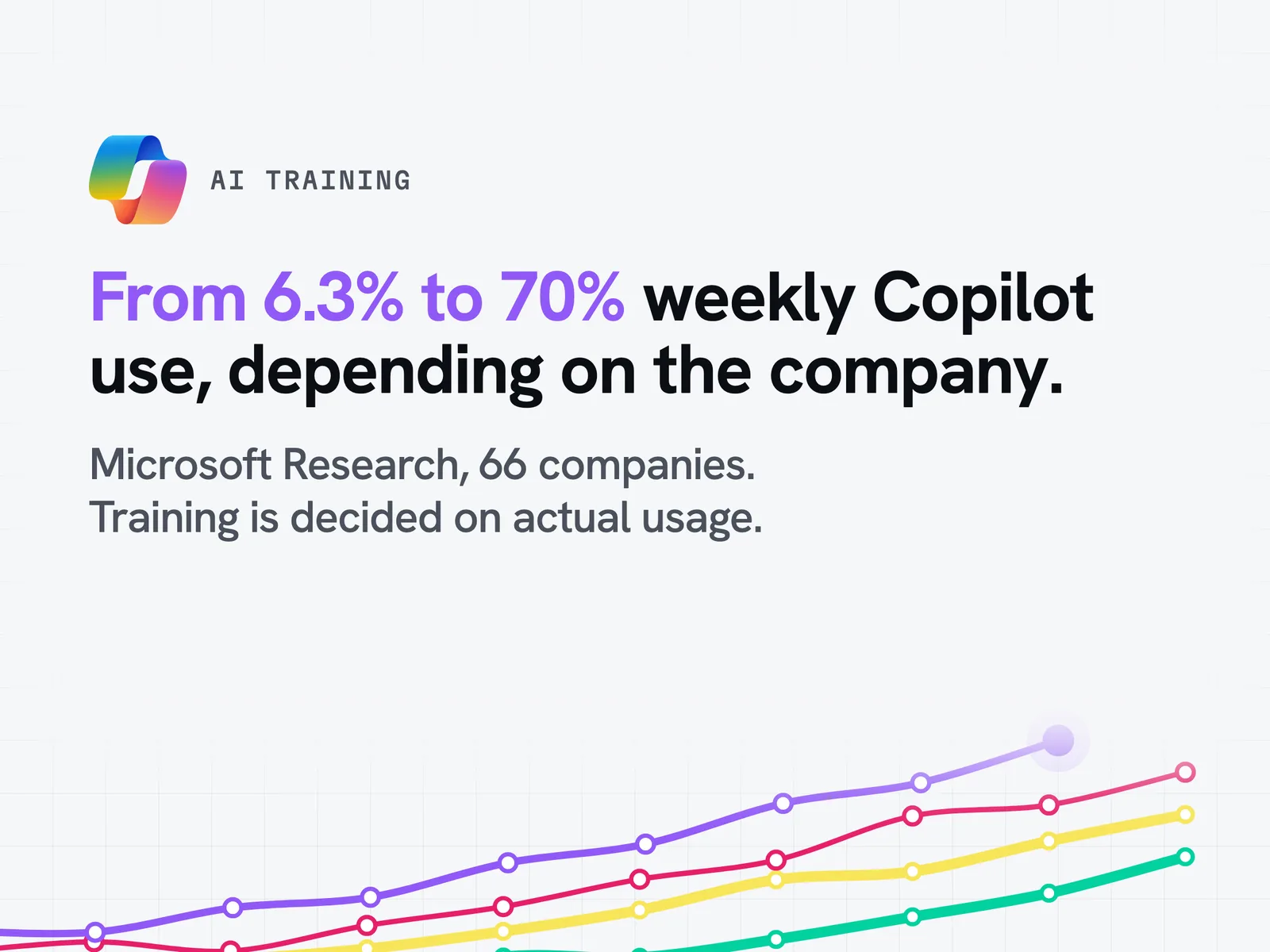
Across 66 large companies, Microsoft Research randomly assigned which employees received Microsoft 365 Copilot. Their usage was then recorded through product telemetry: 7,137 people followed from September 2023 to October 2024. From one company to another, weekly usage ranged from 6.3% to 70%. Differences between firms explain the largest share of the variation, and the authors (Dillon, Jaffe, Immorlica and Stanton) suggest a role for each company's own managerial practices or training, "that we cannot measure".
AI training in companies is therefore best decided on teams' actual usage: before the session, it shows who to train and on what; afterwards, whether usage changed.
Where do you start with AI training in a company?
AI training starts with actual usage, before the programme. Catalogues start from functions (HR, finance, sales); usage shows where a session will help. In order:
- Read actual usage. The logs of the tools you provide (Microsoft 365 Copilot, ChatGPT Enterprise, Claude…) show who uses them and how often. A sample of exchanges, or interviews, shows for which tasks and where requests go unanswered. Automation traffic is set aside.
- Choose the teams and the tasks. Departments where almost nobody uses the tool, and frequent tasks where it struggles, come first.
- Train on those tasks, with the company's shared tools if there are any, rather than touring every feature of the assistant.
- Read usage again in the following weeks, on the same teams and the same tasks.
- Adjust: run another session where usage drops, stop where it holds.
"We've raised their awareness, now we want to train them," the person running AI at a multi-department organisation told us in July. Awareness introduces the tool and its risks to everyone; training works on specific tasks with the teams that need it.
Is AI training mandatory?
AI training is not mandatory in any specific form, but the EU AI Act requires companies to act. Its Article 4, in its current version, requires providers and deployers of AI systems to take measures to develop the AI literacy of their staff, taking into account their knowledge, experience and the context of use. It adds that this obligation does not force them to guarantee a specific level of AI literacy for any individual.
- The obligation to take these measures has applied since 2 February 2025. Supervision, entrusted to national authorities, has applied since 2 August 2026.
- The text was amended by Regulation (EU) 2026/1744, in force since 27 July 2026: the original version asked companies to ensure, to their best extent, a sufficient level of literacy; that requirement is gone.
- According to the European Commission's FAQ, Article 4 does not require measuring employees' knowledge or issuing a certificate. An internal record of trainings and other initiatives is enough to keep track of them.
- The same FAQ warns that simply asking staff to read the tools' instructions might be ineffective, and that a company whose employees write or translate with ChatGPT should inform them of risks such as hallucination.
- Deployers of high-risk systems keep a stricter obligation: training the staff in charge of human oversight (Article 26).
This summary does not replace a lawyer's advice. The regulation asks for measures suited to staff knowledge and context; knowing who does what with which tools is exactly what lets you tailor them. The rest of the obligations are in our guide to AI compliance.
Who should be trained first?
To train employees in AI, start with the teams usage points to, rather than those the org chart points to. Three signals can be read in the logs, by team:
- departments where the tool reaches very few people relative to headcount. The person running AI quoted above saw it in their own organisation: "there are some departments where only one person uses it";
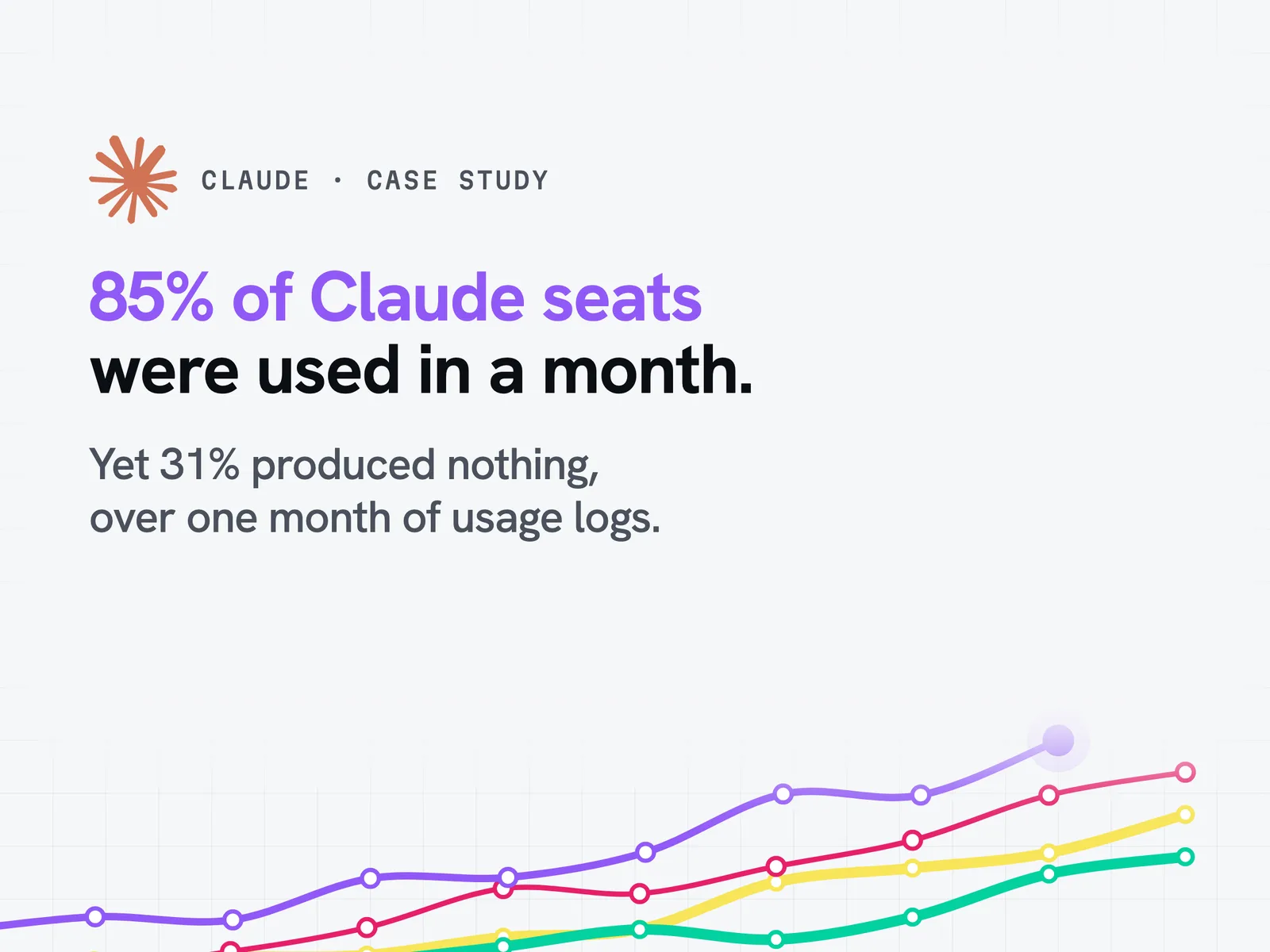
- seats that produced nothing over the month, or stopped after a few tries. At a consulting and training firm, this was the case for 31% of the Claude seats, even though 85% had been used at least once;
- frequent tasks where requests stay unresolved or are redone by hand.
These signals are read by team and by task, on groups large enough that nobody can be recognised: the point is to know where a session will help, without rating anyone. Reading a sample of exchanges means reading requests made to the tool. That reading is framed in writing with the data protection officer. It is also presented to employee representatives and employees before it starts, in line with labour law (check with your lawyer). On the HR side, our article on AI in HR applies this reasoning to the function; for the whole company, see our guide to AI in the enterprise.
What should teams be trained on?
It is better to train teams on their tasks and on shared tools than on the assistant's commands. At that firm, measuring around forty Claude seats over one month showed that 89% of the loads of in-house tools (the "skills") were decided by Claude itself, not by the user. Teaching teams to call those tools by hand would therefore have changed little: each tool's description decided whether it was used.
The same measure shows what sharing changes. A tool deployed across the whole organisation reached 6.4 times more people than the personal version of the same tool. And exchanges in which a shared tool was loaded had 43% fewer unresolved requests. These figures cover one month, one client and Claude tools; a single case is not a rule, and your tools may well be Microsoft's. This case gives a reason to check, in your own logs, who decides to open the tools. The details are in this case study.
"The best thing is to practise," the head of process improvement at a manufacturer told us in early October; they wanted mandated use cases so that teams would get started. Training on tasks does not remove the risks: the Commission's FAQ asks for them to be explained, and an AI usage policy sets what is allowed. According to Cegos's 2026 barometer, a quarter of the HR directors surveyed in France have formalised and shared AI usage rules.
What do studies say about the effect of AI training?
Studies on AI training show that trained employees use AI more, without being able to say whether the training is the cause. Almost all of them are self-reported:
- KPMG, Impact AI and ViaVoice (June 2026, 1,000 private-sector employees in France, surveyed in February): among employees trained in responsible AI, 90% use generative AI in their work, against 47% on average. Only 23% say they received that training.
- BCG (June 2025, more than 10,600 employees and managers in 11 countries): 36% feel adequately trained in AI; those who received five or more hours of training more often become regular users.
- Cegos (2026 barometer, 5,524 employees in 11 countries, 502 of them in France): 25% of French employees have trained in AI through a course or a community of practice offered by their organisation. Overall, nearly one employee in two learned during the year on their own or with peers.
- Insee (July 2026, 11,000 companies with 10 or more employees): lack of expertise is cited by 54% of companies that do not use AI, and by 73% of those with 250 or more employees.
The link between training and usage can run both ways: people also seek training because they already use the tool. KPMG also compares trained employees with the average of all employees, trained ones included, and one of the study's sponsors offers a training programme itself. The only one of these studies that measures usage, Microsoft Research's, does not measure training.
How do you measure the effect of training on usage?
You measure the effect of AI training by comparing the usage of the same teams, on the same tasks, before the training and for several weeks after. The number of attendees and end-of-session satisfaction show that the session took place and was liked; they do not show whether the work changed.
The data and AI project lead at a French regional authority told us in October about 937 participants in an online course, and about 980 in the launch webinars: "we really have strong adoption". Those figures do show that the training reached people; the logs of the following weeks would show whether usage followed.
| What you count | What it tells you | What it does not tell you |
|---|---|---|
| Registrations, attendance, satisfaction | The session took place and was liked | Whether teams use the tool afterwards |
| People active each week, by team | Whether usage rises, and holds after a few weeks | What teams do with it |
| Assisted tasks and unresolved requests | Whether the tool serves the tasks the training targeted | Time saved outside the tool |
| Use of shared tools | Whether teams use what they were shown | Use of personal tools |
Timing matters too. In the Microsoft Research study, usage peaked within the first five weeks, "possibly because of training, novelty, or trial motives". A measurement taken the day after the session may therefore overstate the effect. The person running AI quoted above planned to train in the autumn and to revisit the question "at the very start of next year, to know the actual impact of our training and of usage".
Questions to ask before the training plan
Before signing off a training plan, ask the team that runs your tools and the managers of the teams concerned for these five answers:
- How many people used the tools last month, by team, setting aside automations if there are any?
- Which departments use them little, relative to headcount?
- Which tasks come up most, and where do requests stay unresolved? Vendor exports do not say: you need to read a sample of exchanges, within the framework set out above, or ask the teams.
- Which shared tools already exist, and who uses them?
- Which usage indicator will be read after the training, on which teams, and how many weeks later? Capture the "before" usage now: exports keep only a limited history (thirty days at that firm).
What the measure does not tell you
- Competence: rising usage does not show that the work is done better; quality is checked with the teams.
- Personal tools: according to KPMG, 61% of users go through external consumer AI tools, invisible in the company's logs.
- Cause: usage that rises after training may come from something else, a new tool, a larger team, a busier period.
- People: the measure is read by team and by task, never to judge anyone; it is framed with the data protection officer and presented to employee representatives before it starts.
One question remains that neither the studies cited here nor a single month of logs can settle: how long should usage be observed before saying a training has held? Microsoft Research places the peak within the first five weeks; none of these sources says when the usage that remains becomes a habit.
Idun Group does not sell training. In a year we have carried out more than forty AI diagnostics: our analysis of actual usage combines your tools' logs with interviews with your teams; who to train and on what is one of its deliverables, alongside the ROI of what is used, covered in our article on AI ROI.