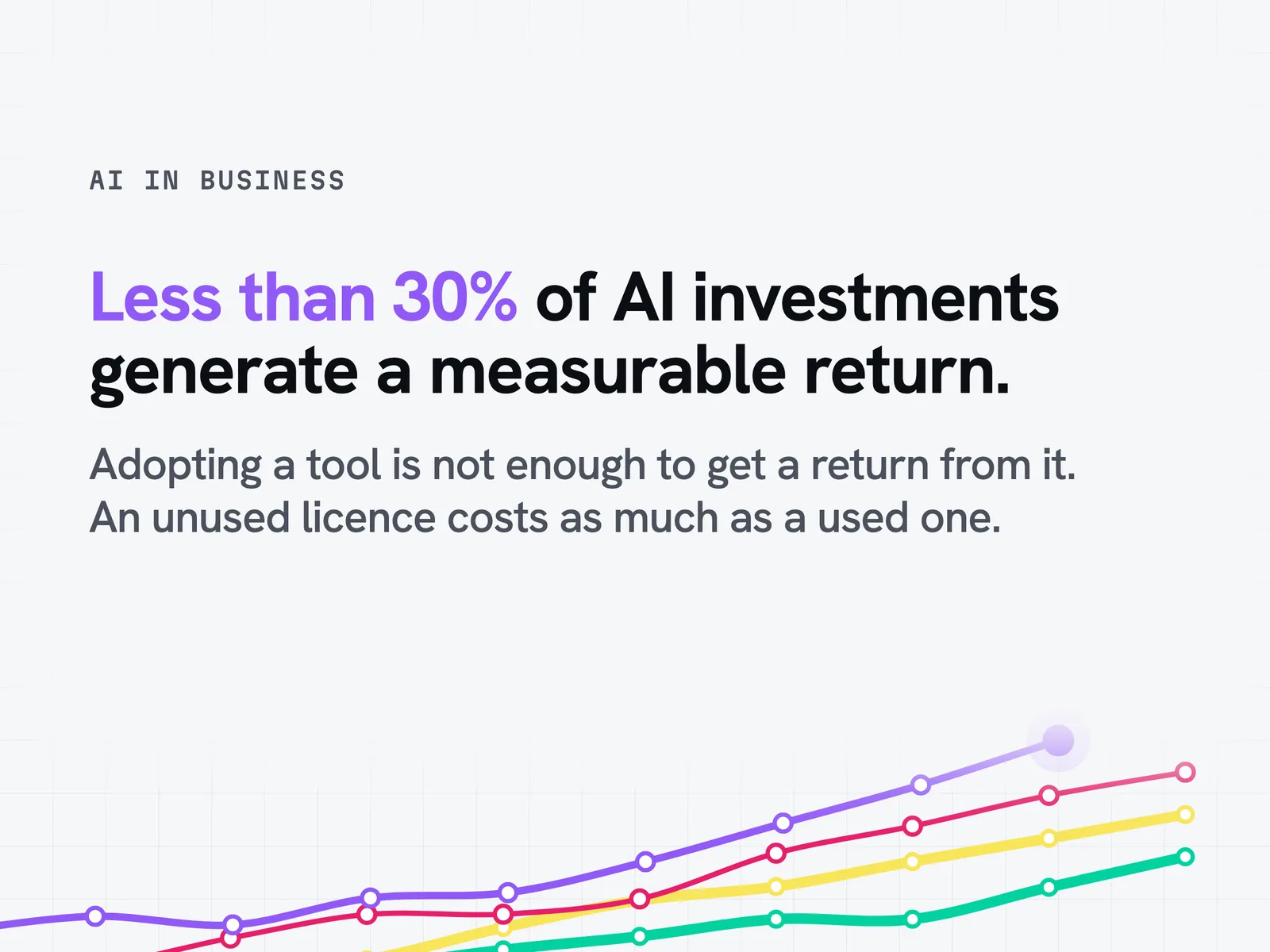
88% of organisations have already deployed artificial intelligence in their day-to-day management. Only 6% get a measurable business impact from it, according to the 2026 AI and HR barometer run by Unow and TalenCo. The human resources function is no exception: HR processes, conversational agents, recruitment tools, talent management, every process has its tool and its use case. What is rarely missing is the tool. What is almost always missing is a measure of what this artificial intelligence actually delivers to the function.
What AI actually changes in the HR function
What we mean by AI applied to human resources
HR AI is not a single piece of software but a family of solutions that automate, summarise or recommend based on human resources data: administration, application screening, payroll, recruitment processes, repetitive tasks. In practice: a conversational agent that reads applications, a tool that writes a job description, software that spots a flight risk in the comments from an annual review. None of this is new in principle. What changes is the scale: these processes now touch the whole cycle, from recruitment to payroll, often without the HR function having an overall view of how these tools are actually used.
Why is the topic becoming urgent for HR leadership now?
Adoption is moving fast among HR managers in France. Nine per cent said they used artificial intelligence tools in their work in 2024. That rate rose to 28% in 2025, then to 33% in 2026. Three years, and adoption has more than tripled: few functions in the company have seen such acceleration. This rapid growth explains why so many organisations are pushing ahead with HR AI without a clear structure to steer it. Usage has multiplied faster than the ability to measure it, and that gap is precisely the problem.
The tools HR teams use without an overall view
Even before an HR AI project is officially launched, teams are already using Copilot, ChatGPT, Claude or Gemini to write a job ad, summarise an interview or prepare an onboarding outline. These uses are not anecdotal. Eighty-one per cent of HR and IT leaders believe artificial intelligence helps their teams work more efficiently, and 79% think it improves the quality of the work produced, according to the Zendesk report on employee experience. So the problem is not a lack of usage. It is the lack of an overall view of that real usage, scattered across several tools and rarely consolidated.
Recruitment and application screening
Recruitment remains the oldest testing ground for HR AI. Writing job ads, screening applications, matching a profile to a job description, preparing interview grids: every step can now rely on an assistant. A single candidate thus passes through several automated touchpoints before a human makes the final decision. The benefit is real when application volume exceeds a team's capacity for manual processing. So is the need for vigilance. A system that pre-screens applications directly influences a hiring decision, and this type of use falls within the most closely watched scope of the EU AI Act, covered further down. Before industrialising this use case, you are better off knowing how many recruiters actually use it, on what volume, and how often a human has to correct each shortlist.
Onboarding new employees
Onboarding lends itself well to automation because it repeats the same questions for every new hire: which documents to provide, which health insurance plan to choose, who to contact about what. A conversational assistant can answer these common questions and free up HR teams' time for more qualitative support, the kind that cannot be delegated. Some organisations go further and generate personalised onboarding journeys, based on the role and the receiving team, as soon as the employee file is created. The use works well as long as it sticks to administration. It becomes more fragile once it touches a new hire's human and social integration, a distinction few organisations draw clearly before rolling the tool out at scale.
Workforce planning and strategic skills management
Strategic workforce and skills planning means anticipating future needs from the company's actual activity. It is a strategic exercise that artificial intelligence could speed up considerably: cross-referencing internal mobility data, declared skills and upcoming projects to spot the roles that will be short-staffed in six months, rather than discovering it once the shortage has set in. In practice, it is also the least exploited use case on the market, even though it accounts for a good share of AI's value potential in HR. This paradox deserves a closer look: it is developed further down, with the figure that illustrates it.
Performance and talent management
In performance management, HR AI summarises evaluations, cross-references several feedback sources and picks up weak signals of disengagement before they turn into departures. A manager preparing an annual review can thus work from a factual summary rather than rereading months of scattered exchanges. The contribution is real for preparation. It is much less so for the final judgement, which remains a human, contextual decision, hard to delegate to a model that knows neither a team's full history nor the organisational tensions of the moment. Treating AI as a preparation tool rather than a decision tool completely changes how you evaluate it.
Training and upskilling
Training benefits directly from HR AI, which can build learning paths from the skills people actually hold and the gaps identified. A skills framework updated automatically from job descriptions and professional development reviews saves the time teams used to spend updating spreadsheets by hand. Yet the issue that matters is not the tool that generates the path. It is the question asked upstream: who needs to upskill, and on what precise topic. That question comes from the real usage observed in the organisation, not from a standard training catalogue applied across the whole company. How to answer it from usage logs, and what the EU AI Act requires: see our article on AI training in companies.
HR administration and document compliance
Summarising contracts, amendments and internal memos remains one of the most mechanical uses of HR AI, and one of the least risky. One vendor in the sector claims time savings of around 50% on automating repetitive tasks and summarising HR documents. That figure remains a commercial ballpark, not a measurement verified at a client, and it varies widely with the volume of documents processed. Administration gains above all in usable data: a file summarised automatically is found faster than a file filed by hand. What matters more than the headline percentage is checking this gain against your own volume of files before building it into a budget.
Pay and benefits
On pay, HR AI is mostly used to prepare salary review campaigns: simulating budget scenarios, spotting internal pay gaps for the same role, tailoring how benefits are communicated to each employee's profile. It is a quieter use case than recruitment or training, less prominent in general guides, but it bears directly on internal fairness. A gap poorly explained by an automated model immediately dents teams' trust, which is why it calls for systematic human review before any individual communication.
Employee experience and internal HR support
Internal HR support, the kind that answers questions about leave, health insurance or payroll, is particularly well suited to a conversational assistant. HR teams no longer handle the most repetitive questions one by one and can focus on the requests that genuinely require human judgement. The employee experience gains in response speed, provided the assistant knows the limits of its scope and hands sensitive topics over to a human.
Why do most HR AI use cases deliver nothing?
The gap between adoption and business impact
The gap opened up in the introduction deserves a closer look, because on its own it sums up the problem most HR AI projects run into: the tool is bought, the pilot is launched, internal communications announce the transformation under way. And then nothing really happens, or so little that nobody bothers to document the failure.
This is not a tool problem. It is a measurement problem. An organisation that does not know how many people actually use an HR AI assistant, on what volume and with what drop-off rate, cannot know whether the project deserves to be continued, scaled up or stopped. It is going on instinct on a topic that should be steered with data, exactly like any other company investment.
The least exploited use case, even though it would weigh the most
The use case that best reveals this gap is forecasting workforce needs. It plateaus at 5% adoption in the 2026 AI and HR barometer, the lowest rate in the entire study. Yet it is one of the uses where the available data is richest: internal mobility, seniority, declared skills, ongoing projects. Everything needed to anticipate a hiring crunch already exists in the HR information system.
This paradox is not specific to the HR function. It reflects a broader trend: organisations invest in the most visible use cases, such as recruitment or internal support, and set aside the ones that require somewhat longer data structuring work but potentially deliver more over time. Measuring real usage is precisely what corrects this bias, by setting the attention given to a use case against the value it actually produces.
What measuring real usage changes in the decision
Two loops stand in contrast here.
| Step | Without usage measurement | With usage measurement |
|---|---|---|
| 1 | An HR AI tool is chosen | An HR AI tool is chosen |
| 2 | A pilot is launched on a limited scope | Usage logs are analysed continuously |
| 3 | No structured tracking of real usage | Scoping interviews complement the factual data |
| 4 | The project quietly fades, with no explicit decision | Explicit decision: industrialise, consolidate or cut |
In the first, and most common, the project fades for lack of structured feedback: nobody knows how many employees are still using it three months after launch, or why some stopped. The topic eventually slips quietly off the priority list.
In the second, the one we apply, real usage is measured from the logs of the tools the company administers: who uses what, how often, with what drop-off rate. This factual data comes on top of scoping interviews with HR leadership, to understand the context behind each figure. The decision that follows is no longer a bet: industrialise what works, consolidate what overlaps across several tools, cut what nobody uses.
How do you know whether an HR AI use case deserves to be industrialised?
The questions to ask before investing further
Before adding budget to an HR AI use case that looks promising, a handful of questions help separate the signal from the noise. How many people actually use it, beyond the few enthusiastic testers at launch? Does the usage rate hold after three months, or does it drop once the novelty wears off? Do the paid licences match real usage, or are half the seats bought sitting idle? Does the use case rely on a tool already widely used elsewhere in the company, at the risk of duplicating it without knowing? What data or connectors are still missing to go further? And above all: who in the HR team would need training for usage to spread beyond the circle of early users?
These questions produce no score and predict no return on investment. They serve to structure a conversation between HR leadership and finance leadership before the budget is committed rather than after. Asking them before renewing or extending a contract often prevents a commitment made solely on the good impression left by a sales demo.
Industrialise, consolidate or cut: the decision that follows measurement
Once real usage is measured, the decision comes down to three possible outcomes.
| Decision | Signal observed | Action |
|---|---|---|
| Industrialise | Broad, repeated usage, low drop-off rate | Roll out to the whole HR function concerned, with a dedicated budget |
| Consolidate | Same use case covered by several tools | Choose a single implementation, stop the duplicates |
| Cut | Marginal usage, paid licences unused | Cancel, or reallocate the budget to a better-measured use case |
This three-way choice looks simple on paper. It is much less so in practice, because it means accepting that a project announced publicly to the HR team can be stopped without it being a personal failure for whoever championed it. It is a question of internal governance as much as method: without this explicit permission to cut, most HR AI projects carry on existing on paper long after they have stopped being used.
The role of interviews alongside usage logs
Usage logs tell you who does what, how many times and at what cost. They do not tell you why a use case was abandoned, or what business constraint explains a low adoption rate. A recruitment manager may have stopped using a screening tool not because it does not work, but because the downstream approval process was never adapted to make use of it.
That is why measuring real usage never replaces scoping interviews with the teams concerned. Logs give the facts: who uses what, how much, with what error rate. Interviews give the intent and the context: why, for which process, under which constraint. It is the combination of the two that makes a realistic action plan possible, never one without the other.
Governance, compliance and ethical issues of AI in HR
What the EU AI Act classifies as high-risk in HR
Recruitment and several HR use cases are not trivial regulatory matters. The EU AI Act classifies as high-risk the systems used to publish or target job ads based on recipients' characteristics, sort or score applications, match CVs to roles, evaluate answers in automated interviews, or support decisions on hiring, promotion or termination of contract.
This regulatory framework should not be read as a constraint that would hold back HR AI adoption. Above all, it calls for exactly what measuring real usage lets you document: who uses which system, within what decision scope, with what traceability. An organisation that already measures its real usage starts its compliance work with a head start.
Algorithmic bias, a documented risk
The risk of algorithmic bias is not a theoretical hypothesis. A widely documented case, cited among others by the DARE Chair at HEC Paris, involves a recruitment engine withdrawn after it penalised applications mentioning certain women's activities, because of historically biased training data.
The lesson goes beyond the isolated case. A model trained on past HR decisions reproduces the biases present in those decisions, including the very ones the company is trying to correct. That is one more reason never to let an artificial intelligence system make a hiring or promotion decision on its own. Human judgement remains the last step, not an option.
We analyse usage, never people
Any measurement of HR AI usage touches a sensitive point: it observes how people work. That is why one principle frames everything we measure: we analyse usage, never people. Results are aggregated by team and by tool, never by person; the exact status of the processing is validated with the client's data protection officer. No workstation scanning. No individual, named reading of any employee's activity.
The goal is never to find out whether a given person works fast enough with a given tool. It is to find out whether a use case, at the level of a team or a function, deserves to be industrialised, consolidated or stopped, with the same rigour as any other investment. This distinction completely changes how a measurement project should be presented to the HR teams concerned.
How does Idun Group measure real AI usage in an HR function?
Analysing the logs and exports of the tools HR teams use
We apply the same usage analysis to the HR function as to the company's other functions: analysing the logs and exports of the platforms the client already administers, whether Azure OpenAI and internal models, Dust, Copilot or custom agents, without installing anything on workstations. By default, the analysis runs in our environment located in the European Union, from the exports provided. If the client's data protection officer or security policy requires it, the pipeline runs within the client's own perimeter. Zero re-instrumentation imposed: we start from the data the system already produces.
For usage that goes through individual accounts on consumer AI tools, the data does not exist directly. We name this blind spot rather than ignore it: what does the company fail to offer internally, so that HR teams go looking for a solution outside? It is a deliverable of the audit, not an automatic measurement. This map of real usage across all tools is the first building block of any decision to industrialise, consolidate or cut.
Adding scoping interviews with HR leadership and IT
Log analysis gives the facts, not the intent. That is why the method always includes scoping interviews with HR leadership and IT leadership. These conversations help explain why a use case was launched, what business constraint it was meant to solve and, where relevant, which organisational obstacles explain lower-than-expected usage.
No data access is requested before an engagement is signed. The method is described from the very first conversation: a read-only connection to existing logs, decided in a scoping meeting according to the client's security and sovereignty constraints. What we offer an HR leader is never raw access to data but fact-based decision support.
The roadmap and the steering committee-ready report
The audit of real AI usage leads to three named deliverables. The map: a map of real usage in the HR function, across all tools. The account: the use cases detected with their estimated return on investment, the waste identified and the full consolidated cost. The course: a six-month to two-year roadmap with a recommendation per use case. This report is designed to be presented as is to the steering committee.
The cost of not measuring mostly shows after the fact. A poorly scoped HR assistant ties up a budget comparable to that of a major digital transformation project, for usage that will never get past the pilot stage if nobody tracks its real adoption.
Who to train and on what: a deliverable of the analysis rather than a training offer?
The audit often surfaces the same finding in the HR function: some use cases are under-used not because the tool is bad, but because nobody was trained to use it beyond the basics. The analysis then identifies who needs to upskill and on which precise topics, based on the real usage observed rather than a generic catalogue.
This upskilling plan comes out of real conversations with the HR teams concerned, never from a standard programme applied uniformly. It serves the employee's development as much as support for the function as a whole. It is not a packaged training offer. It is a deliverable of the analysis, just like the roadmap or the steering committee report.
What should you put in place once HR usage is measured?
In an HR department, measurement brings two things to light: the use cases that come back every week and the licences that sit idle. What remains is to scale up the former and deal with the latter. What works at this stage is tooling, not instructions. Nobody works better because they are told to, whereas usage grows when the right asset is within reach. The three levers below are ranked from least costly to most demanding.
Publish the templates a few HR teams have already built
In any equipped HR department, a handful of people have built their own templates: an annual review outline, a screening grid, a job description template, a set of recurring instructions. These assets usually stay in their personal workspace. Publishing them across the department costs nothing: measurement has already identified the ones that are actually used. A shared template gives the whole team what one person had worked out on their own.
Plug the tool into the systems where HR work already happens
Usage that forces people to switch applications stays occasional. Connecting the assistant to the HR information system, the applicant tracking system or document management removes that break: the answer is built on company documents, in the environment where the question comes up. This lever requires configuration on the IT side and a decision on permissions by department, which makes it a short piece of work rather than a project.
Build agents for recurring HR tasks
When measurement reveals a task handled every week by several people, it becomes a candidate for a shared agent: qualifying an incoming application, answering employees' recurring administrative questions, checking a document's compliance before it goes out. This is the most demanding lever, because it requires design, an owner and long-term maintenance. It is only launched on cases that measurement has identified, never on a hunch.